2026-11-06
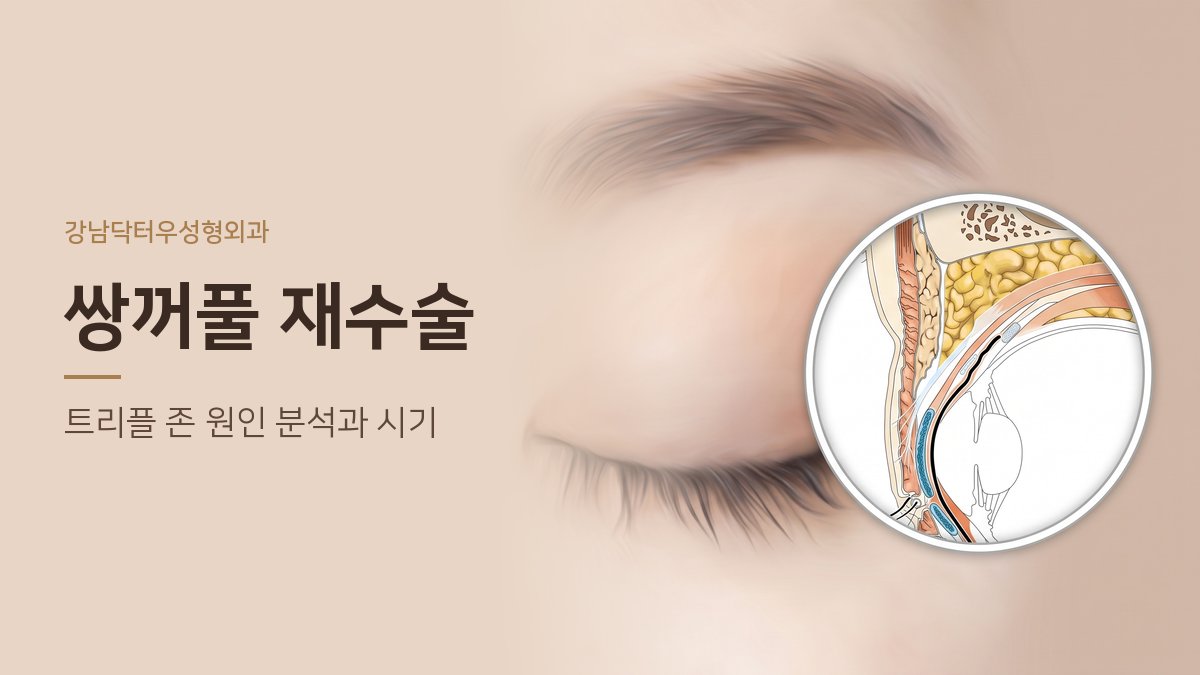
Double Eyelid Revision Surgery: Triple Zone Causes and the Right Timing
Double eyelid revision explained: why lines loosen, look asymmetric, or sit too high, how the three-layer triple zone is checked, and the recommended timing for surgery.
“
I had double eyelid surgery somewhere else, but the line is too high and the two sides look uneven.
When can I have revision surgery again?
Double eyelid revision surgery (eye revision, eyelid revision surgery) is not a procedure for drawing a new line. It is a procedure that returns eyelid structures tangled by a previous surgery to their proper place. Below, we outline where the problem may have started and when revision is best done.
What Does Double Eyelid Revision Correct?
Double eyelid revision is not just about changing the height of the line. Its goal is to release tissue that has adhered or shortened from a previous surgery and restore the eyelid to the structure that allowed it to move naturally.
Common reasons for seeking revision include left-right asymmetry (uneven eyes), a line that is too high or blurry, and a line that has come loose. It is also common to see multiple folds, a hollow above the eye, and drooping eyelids together.
Gangnam Dr. Woo Plastic Surgery calls its revision process “DOUBLE RESET” and approaches it on three principles.
• We aim for connection rather than adhesion
Rather than creating adhesions, we connect the key structures that form the double eyelid.
• We aim for stable fixation rather than strong fixation
Overly strong fixation can itself cause another deformity.
• We remove only the minimum amount of hyungsal (scar tissue)
Hyungsal is scar tissue that forms inside the eyelid after surgery. If it is essential for creating the double eyelid, we do not remove all of it.
Identifying the Layer Where the Problem Started
When a double eyelid has loosened or the line is unsatisfactory, looking for the cause of a failed eye revision only at the line can cause you to miss problems in the deeper layers. The eyelid is broadly divided into three layers. Our clinic calls this the “triple zone”, and we examine all three layers together to find the cause. International literature also explains that a double eyelid forms when the eye-opening muscle, the folding skin, and the fat gliding surface between them each do their job.
| Layer | What It Includes | Problems That Arise in This Layer |
| Front layer | Skin and the muscle that closes the eye | Line set too high and fixed too strongly → sausage-like fold, scarring, asymmetric double eyelid Line set too low and fixed too weakly → blurry double eyelid, hidden double eyelid |
| Gliding layer | Fat between the two layers (gliding surface) | Too much fat or hyungsal removed → sunken eyes, multi-fold double eyelid, loosened double eyelid, drooping eyelid after surgery |
| Back layer | Muscle that opens the eye | Muscle shortened too much → surprised, wide-eyed look, eye does not close fully Muscle too long → eyelid covering the pupil, loosened double eyelid Müller's muscle shortened too much or tied too tightly → tinnitus, pulling toward the temple, eye twitching, headache |
Common revision types by triple zone layer, based on the clinical guidelines of Gangnam Dr. Woo Plastic Surgery

This is an explanatory illustration of an eyelid cross-section. It is not an actual surgical photo.
How Is the Revision Procedure Performed?
• ① Diagnosing the cause
We check the five items below to identify what went wrong.
• ② Releasing adhesions and removing scar tissue
We release the adhered tissue and remove only the minimum amount of hyungsal necessary.
• ③ Reattaching tissue in its proper position
Structures that were attached incorrectly are returned to their original positions. If a significant amount of tissue has been lost, fascia taken from behind the ear or the temple may be used. Fascia is a thin membrane that wraps around muscle.

The three steps of revision surgery shown in order. Illustration for explanation (AI-generated).
If the line has loosened after a non-incision suture method, the suture method can be repeated. However, depending on the condition of the eyelid, the incision method may be more suitable. For eyes operated on with the incision method, the adhered tissue is released first, and then the line is re-established.
Five things checked before revision Double eyelid height · double eyelid angle and fixation strength · whether the gliding layer remains · eye-opening strength · whether the line tends to come loose at the inner corner of the eye (nose side) |
Changes You Can Expect from Revision Surgery
• A line that keeps coming loose
We reinforce the structure at the inner corner of the eye, where the double eyelid tends to loosen, to help the line hold.
• Heavy or overly wide-open eyes
We readjust the distance between the muscle and the tarsal plate (eyelid plate) to match your eye-opening strength.
• Sunken, multi-folded eyelid area
The goal is to rebuild in place the fat gliding surface that was lost in the previous surgery.
However, eyes that have been operated on several times have wider scarring and less remaining skin and fat, which makes correction more difficult. If the two eyes already differed in size, brow position, or eye-opening strength before surgery, some difference may remain even after revision.

When Is the Best Time for Revision Surgery?
The general principle for the timing and interval of eye revision surgery is to wait until the tissue has stabilized. Tissue softens over time, which makes it easier to work with. The criteria at Gangnam Dr. Woo Plastic Surgery are as follows.
• 6 months or more after surgery
We recommend waiting until the tissue has stabilized.
• Within 2 weeks after surgery
Tissue begins to adhere from about two weeks onward. If discomfort and emotional strain are significant, an early corrective procedure can be performed before that point.
• Right now
If daily life has become difficult after a previous surgery, surgery may be decided even before 6 months, after an examination by the clinic director.
Right after surgery, it is hard to judge the final result because of swelling. However, if there is inflammation or the eye does not close well, do not wait; see a doctor right away. Timing varies from person to person, so please decide after consulting a board-certified plastic surgeon.
Side Effects and Post-Surgery Care
The following reactions or side effects may occur after eye revision surgery:
- · Swelling and bruising — most people experience these, and they subside over time.
- · Bleeding, hematoma, or inflammation — may occur.
- · Asymmetry, the line rising again, or multiple folds — may occur. In the early stages, swelling may differ between the two sides, so the lines can look different.
- · The line loosening again or becoming blurry — may occur.
- · Visible scarring — may occur.
- · Dry eyes or the eyes not closing completely — may occur.
- · Need for further surgery — may occur.
In the early days after surgery, a cold compress and keeping your head slightly raised while sleeping may help reduce swelling. For a while, avoid alcohol, smoking, saunas, and strenuous exercise. Do not rub or press on your eyes. Follow your doctor's instructions for washing your face, makeup, and contact lenses.
Recovery time after revision surgery varies from person to person. It is more important to follow your own progress than to compare yourself with others.
Precautions before surgery Please tell us the method and timing of your first surgery, whether it involved an incision, and whether skin or fat was removed. Before-and-after photos are helpful. Please also let us know whether you tend to raise your forehead to open your eyes and whether you are taking any medications. If your vision suddenly becomes blurry or pain, bleeding, or swelling becomes severe after surgery, contact us right away. Phone consultation: 055-338-7585. |

In Closing
If you are considering double eyelid revision surgery, it is better to first check how the structures inside your eyelid have changed due to the previous surgery, rather than looking only at the line you see now. Even with the same concern, the layer causing the problem and the remaining tissue differ from person to person. Please get examined directly by a board-certified plastic surgeon and decide on the timing and method together. When you consult about eye revision surgery, make sure your doctor explains the cause to you. The cost and recovery period of eye revision surgery depend on your condition, and we will go over them during the consultation after your examination.
Frequently Asked Questions
Q. I had surgery elsewhere. Can I still get a revision consultation?
Yes. If you know the timing and method of your previous surgery and the explanations you received at the time, please share as much as you can, as it helps with the diagnosis.
Q. How many times can eye revision surgery be performed?
It is difficult to set a specific number. The more times an eye has been operated on, the harder it is to correct, so we decide after checking the condition of the remaining tissue during the examination.
Q. Wouldn't everything look cleaner if all the hyungsal were removed?
Hyungsal is sometimes needed to support the double eyelid. Removing too much can cause the eye to sink or fold into multiple layers, so we decide how much to remove based on the condition of the remaining skin and tissue.
Q. Can double eyelid revision restore the eye to its original state?
The goal is to return the eye as close as possible to its original structure, but we cannot promise the same result. The original structure, the degree of distortion caused by previous surgery, and the speed of recovery differ from person to person.
Consultation and Booking Information
Phone Consultation / Booking
055-338-7585
You can also request a consultation through the KakaoTalk channel Gangnam Dr. Woo Plastic Surgery. Costs will be explained during the consultation after your examination.
Hours
Mon–Thu: 10:00 AM – 7:00 PM
Fri: 10:00 AM – 9:00 PM
Sat: 10:00 AM – 5:00 PM
Lunch break: 1:00 PM – 2:00 PM
Directions
2nd Floor, Academy Building, 35 Naeoe Jungang-ro, Gimhae-si, Gyeongsangnam-do
It is a 12-minute walk from Exit 1 of Suroewangneung Station on the light rail. For parking, please use Green Parking Lot (12, 101beon-gil, Hambak-ro, Gimhae-si). View on Naver Map
This article is general information prepared by Gangnam Dr. Woo Plastic Surgery based on in-clinic consultation guidelines and abstracts of papers indexed in PubMed. It does not guarantee diagnosis or treatment outcomes. All cited studies are results from other medical institutions, not from this clinic. The effects and recovery periods of surgeries and procedures vary depending on individual conditions, and side effects such as swelling, bruising, bleeding, and inflammation may occur. For more details, please consult a board-certified plastic surgeon during your examination.
#EyeRevisionSurgery #EyelidRevisionSurgery #EyeRevisionConsultation #EyeRevisionSideEffects #EyeRevisionCost #EyeRevisionRecoveryTime #EyeRevisionSwelling #EyeRevisionFailureCause #DoubleEyelidRevisionConsultation #DoubleEyelidRevisionSideEffects #DoubleEyelidRevisionCost #DoubleEyelidRevisionRecoveryTime #AsymmetricEyeCorrection #DoubleEyelidRevisionSurgery #TripleZone #DoubleReset #DoubleEyelidLoosening #AsymmetricDoubleEyelid #EyeRevisionTiming #ScarTissue #GangnamDrWooPlasticSurgery #DrSeungWooLee